
Triphala Rasayana: A Complete Ayurvedic Guide to Preparation, Benefits, Dosage, Safety, and Modern Scientific Evidence

What is Triphala?
Triphala is one of the most widely used and respected polyherbal formulations in Ayurveda. It is prepared from the dried fruits of three medicinal plants in equal proportions:
Phyllanthus emblica (Amalaki/Amla)
Terminalia chebula (Haritaki)
Terminalia bellirica (Bibhitaki)
The word Triphala is derived from the Sanskrit words Tri (three) and Phala (fruits), literally meaning "three fruits."
Classical Ayurvedic texts describe Triphala as a Rasayana (rejuvenative formulation) that promotes longevity and overall health while also serving as an Aushadha (therapeutic medicine) for numerous diseases. Because of its Tridosha-balancing properties, it has remained one of the most frequently prescribed formulations in Ayurvedic practice for centuries. [1–4]
Ingredients of Classical Triphala
Classical Triphala contains equal proportions of:
Haritaki (Terminalia chebula)
Bibhitaki (Terminalia bellirica)
Amalaki (Phyllanthus emblica)
Classical Ratio
Haritaki : Bibhitaki : Amalaki = 1 : 1 : 1 ( Powder Form Ayurvedic Formulary of India)
Haritaki : Bibhitaki : Amalaki = 1 : 2 : 4 (Charak Samhita by number of fruits)


Preparation of Triphala Churna
Mature and healthy fruits are collected, thoroughly cleaned, and preferably dried in the shade in a clean, dry, and well-ventilated environment.
Shade drying helps preserve heat-sensitive phytochemicals. Although fresh Amalaki contains abundant vitamin C, a considerable amount is naturally lost during drying. Avoiding direct sunlight helps minimize further degradation of heat- and light-sensitive constituents.
After complete drying, the fruits should be stored in airtight containers until further processing.
Churna Preparation Process
The dried fruits are deseeded, and only the pericarp (fruit pulp) is used.
Equal quantities of the three ingredients are ground into a fine powder. Traditionally, slow-speed grinding using a stone mill is preferred because it generates less heat and helps preserve thermolabile phytochemicals.
The powder is then sieved through a muslin cloth (Kapadchhan) to obtain a fine and uniform consistency.
Store the finished Triphala Churna in a clean, dry, airtight container protected from moisture and direct sunlight.
Saviryata Avadhi (Shelf Life)
According to Sharangadhara Samhita, the Saviryata Avadhi (period of optimum potency) of Churna is 6 months. [5]
Modern pharmaceutical manufacturing and packaging have significantly improved product stability. Under proper storage conditions, commercially manufactured Triphala Churna may remain chemically stable for up to 2 years, depending on manufacturing quality and packaging. [6]
From a clinical perspective, however, freshly prepared Triphala Churna is generally preferred. In my clinical experience, using the powder within one year of preparation provides the best therapeutic results.
Once the airtight container has been opened, the powder should ideally be consumed within one month, provided it is stored properly in a cool and dry place.
Indications
Triphala is commonly used as a Rasayana and as an adjunct in the management of:
Vibandha (Constipation)
Adhmana (Flatulence)
Anaha (Abdominal bloating/distension)
Sthaulya (Obesity)
Medovriddhi (Dyslipidaemia)
Metabolic syndrome
Shushkakshipaka (Dry Eye Disease)
Eye health and vision support
Khalitya (Androgenetic Alopecia)
Palitya (Premature greying of hair)
Yauvana Pidika (Acne vulgaris)
The selection of Triphala should always be individualized according to the patient's Prakriti, Vikriti, Agni, Bala, and disease condition. [1–4]
Anupana / Sahapana
The choice of Anupana (vehicle taken after medicine) and Sahapana (vehicle taken along with medicine) should be decided by a qualified Ayurvedic physician.
Clinical Purpose | Recommended Anupana |
Rasayana | Lukewarm water (Ushnodaka) |
Constipation | Lukewarm water at bedtime |
Eye disorders | Ghrita (Ghee) |
Kaphaja disorders | Honey (Madhu) |
Pittaja disorders | Ghrita or Milk (Ksheera) |
Vataja disorders | Lukewarm water or Ghrita |
Matra (Dosage)
The usual adult dose of Triphala Churna is 3–6 g, once or twice daily, or as directed by a qualified Ayurvedic physician. [5]
Upadrava (Adverse Effects)
Triphala is generally considered safe when taken in the recommended dosage.
Possible adverse effects include:
Loose stools
Diarrhoea
Abdominal cramps
Bloating
Flatulence
Rarely, prolonged excessive use may contribute to dehydration or electrolyte imbalance due to persistent diarrhoea.
Allergic reactions are uncommon but may occur in individuals who are hypersensitive to any of its ingredients. [6,7]
Ayogya (Contraindications)
Triphala should be used cautiously or avoided in:
Acute or subacute intestinal obstruction
Acute diarrhoea
Active ulcerative colitis
Active Crohn's disease
Severe dehydration
Significant electrolyte imbalance
Known hypersensitivity to any of its ingredients
Pregnancy and Lactation
Pregnancy
The safety of Triphala Churna during pregnancy has not been adequately established by high-quality clinical studies. Therefore, its routine use during pregnancy is not recommended unless prescribed by a qualified Ayurvedic physician.
From the Ayurvedic perspective, Haritaki (Abhaya), one of the ingredients of Triphala, is contraindicated during pregnancy.
अध्वातिखिन्नो बलवर्जितश्च रुक्षः कृशो लंघनकर्षितश्च।
पित्ताधिको गर्भवती च नारी विमुक्तरक्तस्त्वभयां न खादेत॥
Translation
Haritaki should not be consumed by individuals exhausted from prolonged travel or physical exertion, those who are debilitated, excessively dry or emaciated, weakened by prolonged fasting, individuals with aggravated Pitta, pregnant women, or those who have recently experienced significant blood loss. [8]
Lactation
There is insufficient scientific evidence regarding the safety of Triphala during breastfeeding. Classical Ayurvedic texts also do not specifically mention Triphala as contraindicated during lactation.
Therefore, Triphala should be used cautiously during breastfeeding and only under the supervision of a qualified healthcare professional.
Ritu Anusar Triphala (Seasonal Administration)
According to Ayurveda, the therapeutic effect of Triphala may be enhanced by selecting an appropriate Anupana according to the season. ( Refrence taken from Haritaki)
Ritu | Recommended Anupana | Purpose |
Hemanta | Warm water or Ghrita | Vata balance and nourishment |
Shishira | Warm water or Honey | Kapha reduction |
Vasanta | Honey | Kapha-hara and Lekhana |
Grishma | Ghrita or Guda Jala | Cooling and Pitta pacification |
Varsha | Warm water with Saindhava Lavana | Supports Agni |
Sharad | Ghrita or Mishri | Pitta pacification |
Can Triphala Be Customized?
Classical Triphala always contains equal proportions of Haritaki, Bibhitaki, and Amalaki. However, in individualized Ayurvedic practice, experienced physicians may modify these proportions according to the patient's Prakriti, Dosha predominance, Agni, Bala, disease condition, and therapeutic goals.
These modified formulations are not classical Triphala and should only be prescribed by qualified Ayurvedic physicians.
Ratio | Dominant Fruit | Possible Clinical Uses |
1:1:1 | Balanced | General Rasayana |
2:1:1 | Haritaki | Constipation, Vata disorders |
1:2:1 | Bibhitaki | Kapha disorders, obesity |
1:1:2 | Amalaki | Pitta disorders, eye disorders, hyperacidity |
Modern Scientific Evidence
Modern pharmacological studies have demonstrated several biological activities of Triphala, many of which support its traditional Ayurvedic uses.
Antioxidant Activity
Triphala is rich in polyphenols, gallic acid, ellagic acid, tannins, and flavonoids that help reduce oxidative stress. [9–11]
Anti-inflammatory Activity
Experimental studies suggest that Triphala suppresses inflammatory mediators and may reduce chronic inflammation. [9,10]
Digestive Health
Clinical and experimental studies indicate that Triphala improves bowel regularity, gastrointestinal motility, and digestive function. [6,9]
Gut Microbiome
Emerging evidence suggests that Triphala acts as a prebiotic by promoting beneficial intestinal bacteria while reducing pathogenic microorganisms. [10]
Antidiabetic and Lipid-Lowering Effects
Preliminary studies suggest that Triphala may improve glucose metabolism, insulin sensitivity, cholesterol, and triglyceride levels. [9,11]
Oral Health
Clinical studies have demonstrated that Triphala mouthwash may reduce plaque, gingivitis, and oral bacterial counts. [12]
Hepatoprotective, Immunomodulatory, and Antimicrobial Activities
Experimental research suggests that Triphala possesses hepatoprotective, antimicrobial, and immunomodulatory properties, although additional well-designed human studies are needed. [10,11,13]
Anticancer Research
Several laboratory studies have demonstrated that Triphala extracts exhibit antioxidant, antiproliferative, and pro-apoptotic effects against certain cancer cell lines. However, current evidence is insufficient to recommend Triphala for the prevention or treatment of cancer in humans. [14]
Practical Clinical Pearls
Freshly prepared Triphala generally provides superior therapeutic outcomes.
The choice of Anupana significantly influences its therapeutic effect.
Lifestyle modifications and dietary regulation enhance its benefits.
Long-term self-medication should be avoided.
Individuals with chronic illnesses should consult a qualified Ayurvedic physician before prolonged use.
Conclusion
Triphala is one of the finest examples of the holistic wisdom of Ayurveda. More than a gentle bowel regulator, it is a classical Rasayana that supports healthy digestion, metabolism, vision, skin, hair, immunity, and overall well-being.
Modern scientific research increasingly validates many of its traditional uses, particularly its antioxidant, anti-inflammatory, digestive, metabolic, and oral health benefits. Nevertheless, larger, high-quality clinical trials are still required to establish the full extent of its therapeutic potential.
When prepared properly, stored appropriately, and prescribed according to Ayurvedic principles, Triphala remains a safe, versatile, and effective formulation that continues to bridge traditional Ayurvedic knowledge with contemporary scientific understanding.
About Dr. Pankaj Palsra

Dr. Pankaj Palsra Dr. Pankaj Palsra, BAMS, MD (Dravyaguna), is an Ayurvedic Medical Officer (AMO) with expertise in Dravyaguna (Ayurvedic Pharmacology and Medicinal Plants). He is associated with the Research Institute in Indian Systems of Medicine (RIISM), Joginder Nagar, Himachal Pradesh, an institute engaged in the research, conservation, cultivation, identification, and scientific evaluation of medicinal plants and traditional Ayurvedic knowledge.
Dr. Palsra has contributed to Ayurvedic research and scholarly publications in the field of medicinal plants and classical Ayurvedic principles. His academic interests include medicinal plant identification, Dravyaguna, pharmacognosy, and the scientific validation of traditional Ayurvedic formulations.
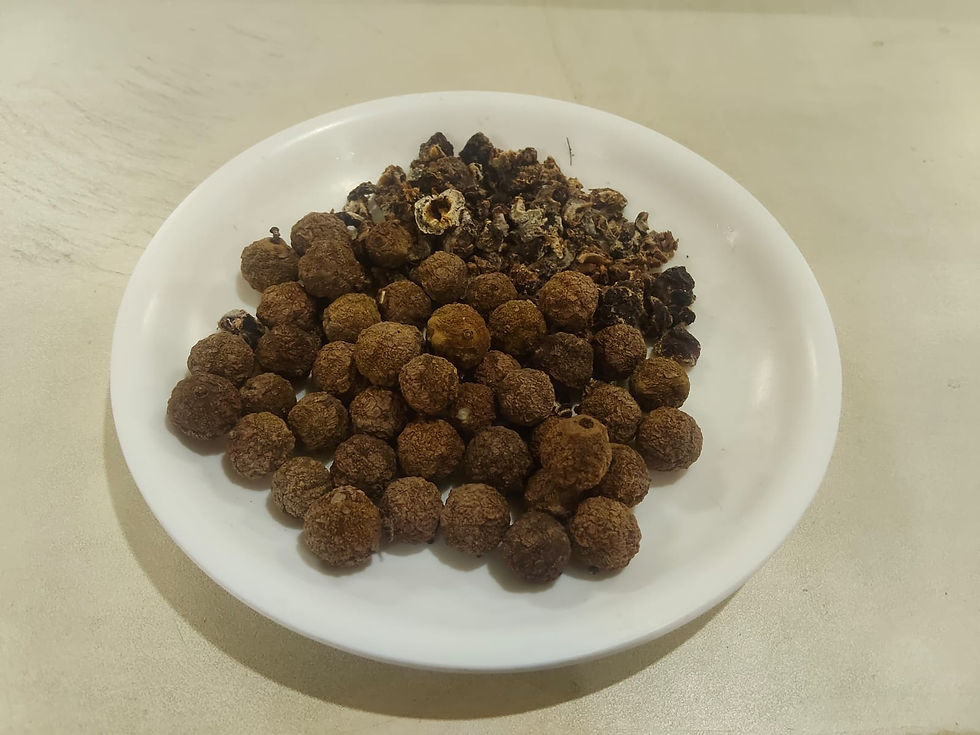
The photographs of Amalaki (Amla), Haritaki, Bibhitaki, and the classical Triphala ingredients featured in this article are courtesy of Dr. Pankaj Palsra and are reproduced with his kind permission. The author gratefully acknowledges his valuable contribution to enhancing the educational quality of this article.
References
1. Sharma PV. Dravyaguna Vijnana. Vol. II. Varanasi: Chaukhambha Bharati Academy.
2. Agnivesha. Charaka Samhita. Chakrapani Commentary. Varanasi: Chaukhambha Orientalia.
3. Vagbhata. Ashtanga Hridaya. Arunadatta Commentary. Varanasi: Chaukhambha Surbharati.
4. Sushruta. Sushruta Samhita. Dalhana Commentary. Varanasi: Chaukhambha Orientalia.
5. Sharangadhara. Sharangadhara Samhita. Madhyama Khanda. Varanasi: Chaukhambha Surbharati.
6. Peterson CT, Denniston K, Chopra D. Therapeutic uses of Triphala in Ayurvedic medicine. J Altern Complement Med. 2017;23(8):607–614.
7. Ulbricht C, et al. An evidence-based systematic review of Triphala. J Diet Suppl. 2017.
8. Bhavamishra. Bhavaprakasha Nighantu. Haritakyadi Varga, Verse 35. Varanasi: Chaukhambha Bharati Academy.
9. Baliga MS. Triphala, Ayurvedic formulation for treating and preventing disease: A review. J Altern Complement Med.
10. Srikumar R, et al. Immunomodulatory effects of Triphala. J Ethnopharmacol.
11. Naik GH, Priyadarsini KI, Mohan H. Evaluation of the antioxidant activity of Triphala. Phytother Res.
12. Naiktari RS, et al. Clinical efficacy of Triphala mouthwash in plaque-induced gingivitis. J Periodontol.
13. Gupta A, et al. Phytochemistry and pharmacological properties of Triphala: A review. Chin J Integr Med.
14. Deep G, et al. Chemopreventive and therapeutic potential of Triphala in cancer research. J Exp Ther Oncol.
Comments